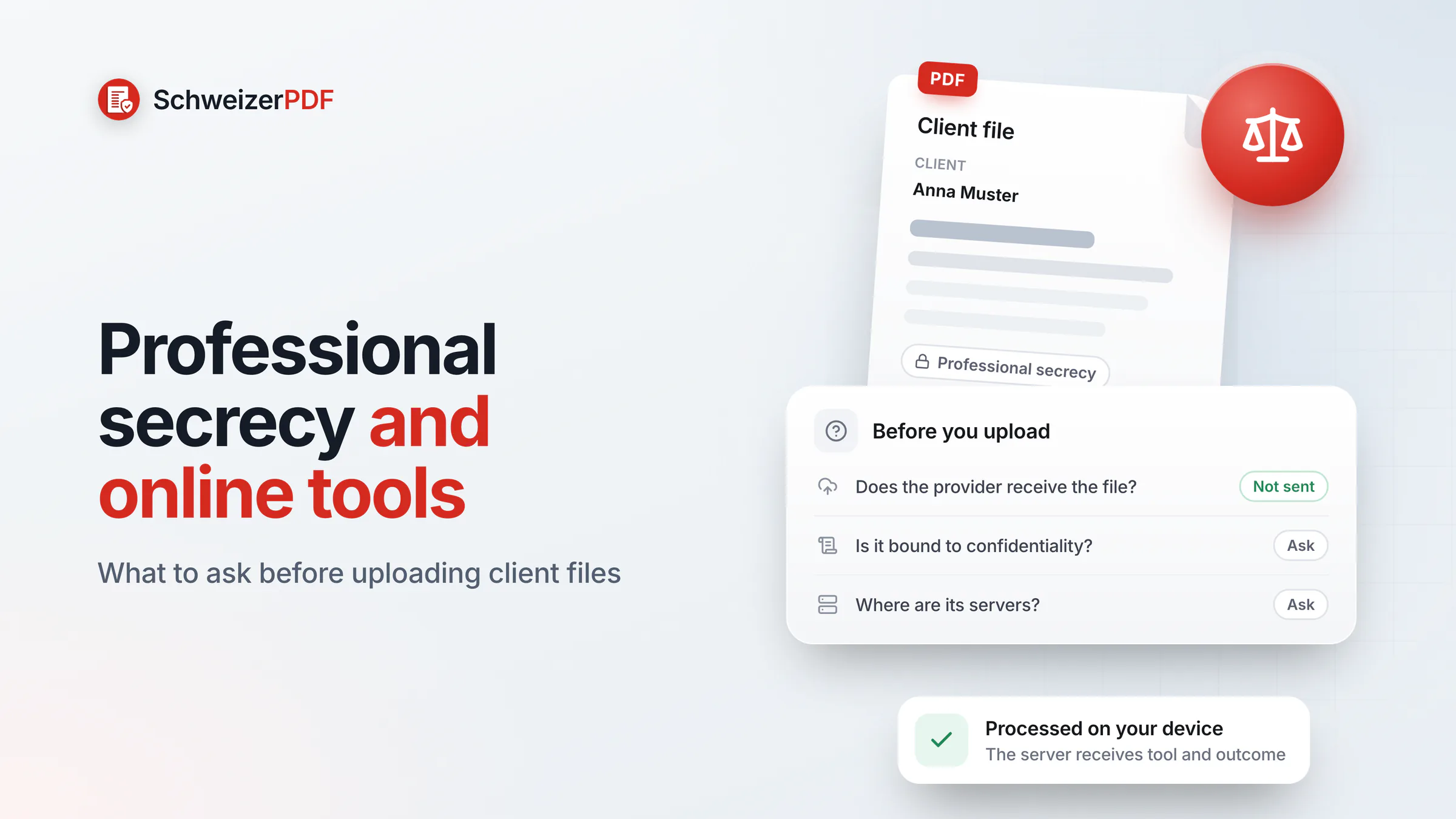
If you are bound by professional secrecy — as a lawyer, doctor, psychologist, notary or auditor, or as their assistant — uploading a client's or patient's document to an online PDF tool hands what it contains to a third party. Whether that is permissible depends on your profession, your contracts, the client's consent and how the provider is bound. It is a question to settle before the upload, not after.
A tool that processes the file in your browser does not receive the document, so that question does not arise for the document itself. It does not settle everything else. This article explains what Art. 321 of the Swiss Criminal Code covers, which other secrecy duties exist, what to ask any online tool and where local processing helps — and where it does not.
What Art. 321 of the Swiss Criminal Code covers
Art. 321 of the Swiss Criminal Code (SCC, SR 311.0) names the professions bound by professional secrecy: members of the clergy, lawyers, defence lawyers, notaries, patent attorneys, auditors bound to confidentiality under the Code of Obligations, doctors, dentists, chiropractors, pharmacists, midwives, psychologists, nurses, physiotherapists, occupational therapists, dieticians, optometrists, osteopaths — and their assistants. Students are covered for what they learn during their studies. The text is on fedlex.admin.ch.
- What is protected: confidential information confided to the professional in that capacity, or learnt in the practice of the profession.
- The consequence: disclosing it is an offence prosecuted on complaint, with a custodial sentence of up to three years or a monetary penalty. The duty continues after the professional activity or the studies end.
- The exceptions in the article: disclosure is not punishable with the consent of the person concerned, or with written authorisation from the superior or supervisory authority, given on the professional's request. Federal and cantonal rules on duties to report, to testify and to provide information to an authority are reserved.
The article names assistants — the staff of a practice or a firm. Whether, and under which conditions, an external IT or software provider can be treated like an assistant is a question discussed in legal practice. This article does not answer it; your professional association or a lawyer can.
Other secrecy duties beyond Art. 321
Art. 321 is not the only rule. Depending on your activity, others may apply alongside it or instead of it:
- Official secrecy (Art. 320 SCC) for members of authorities and public officials.
- Banking secrecy under the Banking Act, for banks and their staff.
- The professional duty of confidentiality in the FADP (Art. 62): anyone who intentionally discloses secret personal data learnt while practising a profession that requires knowledge of such data can be fined, on complaint. It is not limited to the professions listed in Art. 321 — which matters, for example, for fiduciaries handling payroll and tax files.
- Contractual confidentiality in mandates, employment contracts and non-disclosure agreements, and professional rules set by federal or cantonal law for certain professions.
Why an upload is a question of secrecy, not only of data protection
An upload-based PDF website receives the whole document — every page, every name, every diagnosis or account number in it. Under the Swiss Federal Act on Data Protection (FADP/nDSG), a provider that processes personal data on your behalf is usually a processor. The FADP allows assigning processing to a processor only if the data is processed as you yourself would be permitted to, and if no statutory or contractual duty of confidentiality prohibits it; you must also satisfy yourself that the processor can ensure data security (Art. 9, fedlex.admin.ch). A secrecy duty is therefore directly relevant to whether you may involve a provider at all.
Where professionals do use outside providers, the questions they typically settle in advance are a written contract with confidentiality obligations, where the data is stored and who can access it, the technical safeguards, and sometimes the client's consent. With a website found by a search engine for a one-off conversion, such questions are rarely settled. Servers abroad add the rules on disclosure abroad — explained briefly in why your PDF tool shouldn't see your documents.
Questions to ask before using an online tool for client files
- Does the provider receive the document? If not, can you check that yourself — for example in your browser's network log?
- If it does: where is the file stored, for how long, who can access it, and does the provider use further subcontractors?
- Is there a contract that binds the provider to confidentiality — and does your secrecy duty allow involving it at all?
- Are the servers in Switzerland or abroad?
- What does the provider store about you — account, usage, logs — and could that reveal anything about your clients?
- Has your professional association or supervisory authority issued guidance on cloud and online services?
What local processing changes — and what it does not
SchweizerPDF processes PDFs in your browser, on your device. The document is not transmitted to us: for each run our server receives only the tool id and the outcome — no file name, size, page count, text or metadata. You can confirm this in the network log; where your files are processed shows how.
| What leaves your device? | Upload-based PDF website | SchweizerPDF (in the browser) |
|---|---|---|
| The document and its content | Copied to the provider's server | Stays on your device |
| File name, size, page count | Usually known to the provider | Not sent |
| Per run | The file and its result | Tool id and outcome |
| About you | Depends on the provider | Account, sessions, usage ledger (13 months), billing records, e-mail and security logs |
What local processing does not change:
- Account data still exists. Your e-mail address, plan, usage ledger and billing records are stored on our server — listed in what we store.
- Your own setup counts. If your Downloads folder syncs to a cloud storage, or you e-mail the result, that is a transfer of its own.
- Your device must be trustworthy. A compromised computer or a browser extension that can read every page sees what the page shows.
- It is not a legal assessment. Local processing means one transfer fewer to evaluate. It does not decide whether your way of working meets your secrecy duties.
Practical habits for law firms, practices and fiduciaries
- Redact before you share with opposing parties, insurers or authorities — removed for good, then reviewed: see how Black out (redact) works and redacting AHV numbers and IBANs.
- Make scans searchable on your device instead of sending them to a recognition service: OCR for a scanned contract.
- Protect what you send by e-mail with an open password shared through another channel: sending confidential documents by email.
- Remove hidden data — comments, earlier versions, attachments — before a file leaves the firm: hidden data in PDFs.
- Write it down. An internal rule on which tools may be used for client files makes the choice visible and easier to review.
How these tools fit each profession: law firms, medical practices and fiduciaries.
Frequently asked questions
Is using an online PDF tool a breach of professional secrecy?
There is no general answer. It depends on whether the provider receives the secret, on your profession and its rules, on contracts and on the client's consent. Ask your professional association or a lawyer before you use an upload-based service for client documents.
Does a client's consent solve the question?
Under Art. 321, disclosure with the consent of the person concerned is not punishable. What the consent must cover, in which form, and whether other rules still apply are questions to clarify for your situation.
Are fiduciaries bound by Art. 321?
Fiduciaries are not named in Art. 321; auditors bound to confidentiality under the Code of Obligations are. Fiduciaries can be bound by the professional duty of confidentiality in Art. 62 FADP and by their contracts.
Does SchweizerPDF see my client files?
No. Files are read and processed in your browser; per run our server receives only the tool id and the outcome. Your account data is stored, as described on the security page.
For the data protection habits behind every document, read the FADP checklist for everyday PDFs. To try the tools on your own device, create a free account.
General information
This article is general information, not legal advice. The description of Art. 321 SCC, the FADP and other secrecy duties is simplified and does not say whether a particular tool or way of working is permitted for you. For your own obligations, consult your professional association, your supervisory authority or a lawyer.